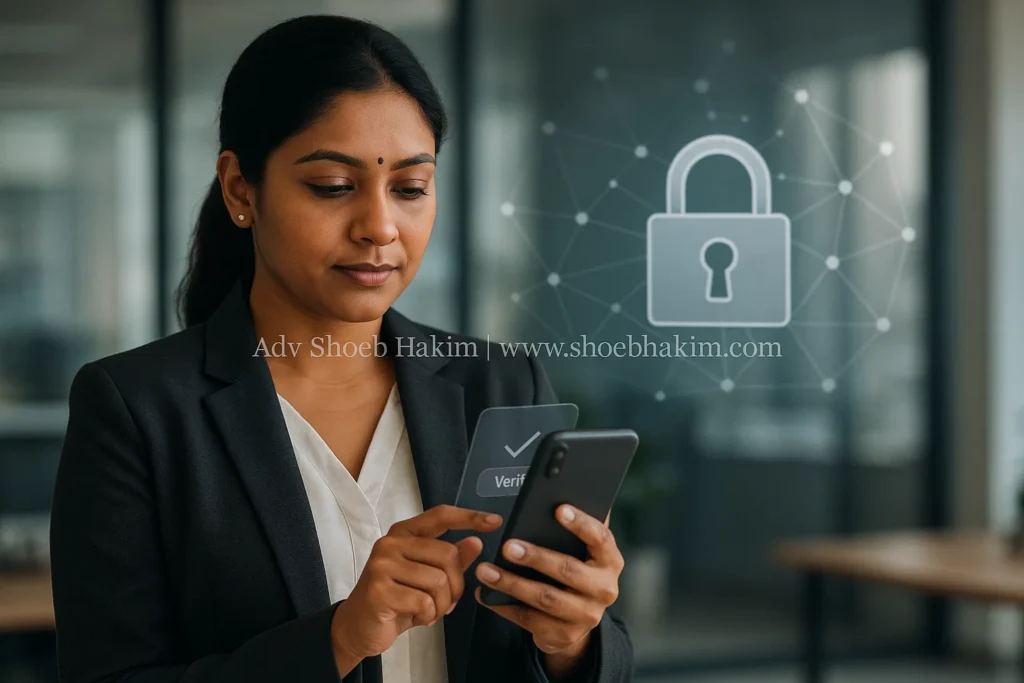
Introduction: The Digital Identity Crossroads
For the User: Imagine your WhatsApp account—years of personal chats, business contacts, and family groups—suddenly inaccessible because you didn’t link it to a mobile number. Or worse, facing legal scrutiny because an unverified account was misused for fraud. This is the new reality as India’s Department of Telecommunications (DoT) orders Significant Social Media Intermediaries (SSMIs) like WhatsApp, Telegram, and others to enforce SIM-binding within 90 days.
For the Legal Professional: Beyond the headlines lies a complex web of compliance. You’re advising a tech client on implementing this mandate while navigating the Bharatiya Nagarik Suraksha Sanhita (BNSS), 2023’s expanded electronic evidence rules, the privacy jurisprudence under K.S. Puttaswamy, and intermediary liability under the IT Act, 2000. The challenge is twofold: ensuring technical compliance while safeguarding client rights against potential overreach.
This article provides a dual-path analysis. For users, we demystify the mandate’s impact on daily digital life. For lawyers and compliance officers, we delve into the statutory landscape, precedent-driven risks, and strategic advisory frameworks necessary to navigate this transformative shift in digital identity verification.
The User’s Perspective: Understanding SIM-Binding & Your Digital Rights

SIM-binding, or mandatory linking of a messaging/ social media account to a verified Indian mobile number, shifts the paradigm from anonymity to verified identity online. The DoT’s directive under the Telecom Act and IT Act, 2000 (Section 79) aims to traceability for law enforcement, but it triggers significant user-side concerns.
H3: What This Means for Your Daily Digital Use
Account Access: Your account’s accessibility becomes tied to your active SIM. Changing numbers will require a mandatory re-verification process.
Multi-Device Use: Services like WhatsApp’s “multi-device” feature that allow web/desktop use without phone connectivity may face new restrictions or require re-authentication.
International Travel: Using Indian SIM-based apps abroad may involve complexities, especially if the SIM is inactive or in roaming mode.
The Privacy vs. Security Balance: Your Legal Rights
The mandate operates at the intersection of two fundamental rights: Privacy and State Security.
The Privacy Right: Established in the landmark case of Justice K.S. Puttaswamy (Retd.) vs. Union of India (2017) 10 SCC 1, this judgment affirmed privacy as a fundamental right under Article 21 of the Constitution. Any state measure that infringes upon it must satisfy the tests of legality, necessity, and proportionality.
The State’s Argument: The government’s likely defense will cite “legitimate state interest” in preventing cybercrime, terrorism, and misinformation, as seen in arguments during cases like Shreya Singhal vs. Union of India.
User’s Checklist: Steps to Prepare
Verify Current Linking: Check if your primary messaging apps are already linked to your active mobile number.
Secure Your SIM: Ensure your mobile connection is registered in your name (KYC-compliant) to avoid disconnection.
Backup Data: Regularly backup chats and media (using local or encrypted cloud backups) to prevent data loss during any transition.
Understand Takedown Rules: Know that traceability can lead to faster law enforcement action. Be mindful of shared content.
The Legal & Professional Perspective: Navigating Compliance & Litigation Risks
For legal practitioners advising intermediaries, corporates, or individuals, this mandate opens several fronts of analysis.
H3: Statutory Framework: IT Act, BNS & Telecom Laws
The directive is not born in a vacuum. It interlinks multiple statutes:
Information Technology Act, 2000 (Amended): Section 79 provides the safe harbor for intermediaries. Compliance with Due Diligence guidelines (which may be amended to include SIM-binding) is key to retaining immunity.
The Bharatiya Nyaya Sanhita (BNS), 2023: Sections dealing with cyber fraud (Sec. 318), identity theft (Sec. 319), and criminal intimidation by anonymity (Sec. 356) gain sharper teeth with verified identities. Evidentiary procedures for digital evidence are now under the BNSS, 2023.
Indian Evidence Act, 1872 (as amended) & BNSS: Section 65B compliance for electronic evidence remains paramount. The case of Arjun Panditrao Khotkar vs. Kailash Kushanrao Gorantyal (2020) 7 SCC 1 made a Section 65B certificate mandatory for admissibility. SIM-binding creates a more robust chain of custody, linking a digital act to a verified number and, by extension, a KYC-ed individual.
Judicial Precedents & Potential Challenges (Case Law Analysis)
Courts have historically scrutinized broad digital mandates. This directive will likely be tested on following grounds, informed by past precedents:
Test of Proportionality & Vagueness: The Shreya Singhal vs. Union of India (2015) 5 SCC 1 case struck down Section 66A of the IT Act for being “vague and overbroad.” Any enforcement rule that does not precisely define the scope of “traceability” or fails to protect core communication privacy may face similar challenges.
Intermediary Liability Evolution: The trajectory from Avnish Bajaj vs. State (NCT of Delhi) (2005) to Shreya Singhal shows courts narrowing intermediary liability to actions following specific court/government orders, not proactive mass surveillance. A mandate for en masse data linkage pushes the boundary of this principle.
Privacy as a Fundamental Right: The Puttaswamy case is the bedrock. Any legal challenge will argue whether SIM-binding for all users is the least restrictive means to achieve the state’s goal of preventing crime.
Practice Tip for Lawyers:
When advising client companies (SSMIs), frame compliance as a “Privacy by Design” challenge. lawyer for implementation that includes:
End-to-end encryption remains intact for message content.
Data minimization (store only the number link, not unrelated metadata).
Clear user communication on how data will be used, as per IT Rules, 2021.
Corporate Compliance Roadmap (For In-House Counsel & Law Firms)
A 90-Day Action Plan for Intermediaries:
Week 1-2: Legal Audit. Map the mandate’s requirements against existing privacy policies, terms of service, and data architecture.
Week 3-6: Technical & UX Design. Develop a seamless, secure verification flow. Plan for edge cases (NRI users, business accounts).
Week 7-10: User Communication Strategy. Draft clear, multi-language notifications explaining the “why” and “how,” minimizing user friction and potential backlash.
Week 11-12: Internal Training & Grievance Redressal. Train customer support and legal teams on the new protocol and potential user queries/complaints.
Bridging the Gap: Managing Expectations in a SIM-Bound Digital India
This mandate will redefine the lawyer-client dynamic in cyber-related matters.
For Clients: Explain that while privacy feels reduced, account security against takeover and recourse against online fraud may improve. The legal system will have a clearer path to pursue malicious actors, as seen in cases like State (NCT of Delhi) vs. Navjot Sandhu (2005) 11 SCC 600, where call records were pivotal. However, emphasize the importance of being more disciplined in group additions and content sharing.
For Lawyers: Your role evolves from just litigation to preventive advisory. Counsel clients (individuals and businesses) on:
Digital Hygiene: Using official apps, avoiding third-party mods.
Evidence Preservation: How to legally preserve chats (S. 65B) for potential disputes.
Rights Awareness: When and how to challenge unlawful data access requests, leaning on principles from Puttaswamy.
The Core Translation: “Traceability” for the state means “reduced anonymity” for the user. It doesn’t mean blanket surveillance of content but creates a digital identity layer. A lawyer’s job is to ensure this layer is not misused.
Frequently Asked Questions (FAQ)
Q1: What happens if I don’t link my WhatsApp/Telegram to my SIM within 90 days?
A: As per the DoT directive, non-compliant accounts are likely to be restricted or suspended by the platform, losing functionality until verification is completed.
Q2: Does SIM-binding mean the government can read my private messages?
A: No. The mandate is about identity verification, not breaking encryption. Platforms like WhatsApp use end-to-end encryption (E2EE), meaning message content remains private between sender and receiver. The government can, through due legal process, request account information (like linked number) from the company, not the message content itself.
Q3: How will this help in fighting cybercrime?
A: It creates a crucial first link in the investigation chain. Earlier, anonymous accounts were untraceable. Now, law enforcement can, with legal approval, trace an account to a KYC-ed mobile number, significantly aiding in investigating cases of online fraud (BNS Sec. 318) or cyber defamation.
Q4: I am an NRI with an Indian number. How does this affect me?
A: The mandate applies to Indian mobile numbers. If you use an Indian SIM, you must comply. If you use a foreign number, you will likely fall under that country’s jurisdiction for the app’s services. Platforms will need to clarify their geo-specific rollout plans.
Q5: Can this mandate be legally challenged?
A: Yes, and it likely will be. Any challenge would be based on the right to privacy (Puttaswamy case) and the test of proportionality, arguing that the measure is overbroad and not the least restrictive way to achieve lawful objectives.
For Individuals & Business Users: Concerned about how this change impacts your digital privacy or business communications? Consult with a cyber law expert from our network at Vakilverse.com to audit your digital footprint and understand your rights.
For Lawyers & Legal Professionals: Staying ahead of the curve on evolving digital evidence laws under BNSS, 2023 and intermediary compliance is crucial. Explore our dedicated professional resources and webinars on mastering tech-law interfaces for effective client advisory and litigation strategy. [Link to a future ‘For Lawyers’ section].
Internal Link Suggestions:
*Related: A Guide to Section 65B – Electronic Evidence in Indian Courts*
Related: Understanding the New Bharatiya Nyaya Sanhita: Cyber Offences Explained
Related: K.S. Puttaswamy Case: The Complete Breakdown of the Right to Privacy
Disclaimer: This article is for informational purposes only and does not constitute legal advice. Please consult with a qualified legal professional for advice on your specific situation. The analysis of case laws and statutes is based on publicly available information and interpretations by Vakilverse legal team.
Meta Description: DoT mandates SIM-linking for WhatsApp/Telegram in 90 days. Learn compliance steps, privacy impacts, and legal analysis for users and professionals. Expert insights by Vakilverse.
Slug: dot-sim-binding-mandate-whatsapp-telegram-compliance-legal-analysis
Serial Number: VV/DEC/W2/2025-12-02/336/ADVSHOART7F9K2
Meta Robots: index, follow, max-snippet:150, max-image-preview:large
Breadcrumbs Title: Home > Cyber Law > DoT SIM-Binding Mandate
#CyberLaw #DigitalForensics #IndianLawyer # #LegalTech #CyberCrimeIndia #lawyer #ITActIndia #BNS2023 #DataPrivacy #DigitalIndia #LegalCompliance #CyberSecurityLaw #SocialMediaLaw
SOCIAL MEDIA VERSIONS
LinkedIn (Thought Leadership):
The DoT’s 90-day SIM-binding mandate for WhatsApp & Telegram is more than a tech update—it’s a legal inflection point. For practitioners, it demands analyzing converging statutes (IT Act, BNS 2023) and delicate privacy-security balances set by precedents like Puttaswamy and Shreya Singhal. How are you advising clients on compliant, rights-respecting implementation?
#CyberLaw #LegalTech #DataPrivacy #Compliance #IndianLawyer #
CTA: Read the full analysis and practical checklist.
Facebook (Discussion Driver):
Got that “link your number” notification yet? The government has set a 90-day deadline for linking your WhatsApp/Telegram to your SIM. While aimed at safety, what does it mean for your privacy and account access? And what are the legal principles at stake? We break it down in plain language.
#WhatsApp #Telegram #DigitalIndia #PrivacyRights #CyberSafety CTA: Read the full analysis and practical checklist.
Twitter / X (Conversational Engagement):
⏳ 90-day countdown begins: DoT orders SIM-binding for WhatsApp, Telegram, others.
🤔 What does it mean for you? (Spoiler: Check your linked number).
⚖️ What does it mean for the law? (Spoiler: IT Act + BNS 2023 + Privacy jurisprudence).
A quick thread on the key points:
#SimBinding #DigitalIdentity #CyberLawIndia #
CTA: Read the full analysis and practical checklist.